Blog
Europe Lighting Market Size, Share and Analysis, 2033

Europe Lighting Market Size
The Europe lighting market size was valued at USD 39.01 billion in 2024 and is projected to reach USD 70.81 billion by 2033 from USD 41.68 billion in 2025, growing at a CAGR of 6.85%.
Lighting refers to the artificial illumination systems for residential commercial industrial and public infrastructure applications with a strong emphasis on energy efficiency human centric design and digital integration. Unlike general electrical goods lighting in Europe is increasingly defined by its role in enhancing well being reducing carbon emissions and enabling smart environments through connected technologies. According to sources, Lighting accounts for a notable share of total electricity consumption within European buildings, which emphasizes its significance in the overall energy landscape. Moreover, the European Union has a substantial number of households, with high market penetration of lighting infrastructure across dwellings. Furthermore, the European Commission’s Ecodesign for Energy Related Products Regulation has progressively phased out inefficient conventional lamps over several years, mandating energy efficiency thresholds that have driven rapid LED adoption. The significant dominance of LED technology in new lighting sales, alongside emerging principles in modern building design, positions the European lighting market as a key contributor to the continent’s energy transition goals.
MARKET DRIVERS
EU Energy Efficiency Mandates Accelerate LED Retrofit Adoption
Stringent regulatory frameworks that/which prioritize energy savings and carbon reduction in built environments are fuelling the growth of the Europe lighting market. The European Union’s Ecodesign Regulation for lighting products, effective since 2021, established ambitious minimum efficiency requirements for light sources, leading to the substantial phase-out of many non-LED technologies across the European market. In addition, the German Energy Agency (dena) and various national energy efficiency programs have consistently promoted the widespread retrofitting of public lighting infrastructure, driving a general increase in the adoption of more efficient LED systems across municipalities. Similarly, as per the French Environment and Energy Management Agency (ADEME), the conversion of municipal streetlights to LED technology is a significant national trend that results in substantial reductions in public lighting electricity consumption across local government areas. The EU’s Energy Performance of Buildings Directive further mandates that all new constructions and major renovations incorporate high efficiency lighting with automatic controls. These policies create structural demand independent of consumer cycles ensuring sustained LED deployment across public and private sectors.
Human Centric Lighting Gains Traction in Health and Education Settings
Lighting is increasingly valued for its impact on human physiology cognitive performance and emotional well-being, beyond energy savings, which further propels the expansion of the Europe lighting market. This drives adoption of tunable and circadian aligned systems. New office and educational initiatives across certain European regions frequently incorporate human-centric lighting systems, intended to support concentration and mitigate fatigue. Reports from Scandinavian institutions suggest a decrease in complaints related to eye strain and headaches within classrooms that utilize dynamic white lighting to emulate natural daylight rhythms. In the Netherlands, nursing facilities that have adopted circadian rhythm-supporting lighting solutions have observed better sleep patterns and fewer sundowning effects among residents with dementia. A European standards body is in the process of establishing technical specifications to standardize the measurement of lighting’s impact on circadian rhythms, which aims to provide a consistent scientific basis for the technology. Growing evidence regarding light’s biological effects is driving a shift from purely utilitarian lighting to therapeutic applications within Europe’s health-conscious built environment.
MARKET RESTRAINTS
Raw Material Volatility and Rare Earth Dependency Increase Cost Instability
Persistent pressure from fluctuating prices of critical raw materials, especially rare earth elements used in LED phosphors and drivers acts as a serious restraint to the Europe lighting market. Europium, terbium, and yttrium are classified as critical raw materials, largely imported from outside the European Union. Terbium oxide prices experienced an increase in 2024 due to supply chain factors. The costs associated with copper and aluminum, which are used in various components, also saw price increases. These inputs constitute up to forty percent of an LED luminaire’s bill of materials making cost pass through difficult in competitive tenders. Many manufacturers absorbed these increases, which compresses margins. Until circular supply chains or phosphor free technologies mature lighting companies remain exposed to geopolitical supply risks and cost volatility.
Complex E Waste Recycling Infrastructure Hinders Circular Transition
The region struggles with effective end of life management for luminaires, despite high LED adoption, which ultimately obstructs the expansion of the Europe lighting market. This is due to fragmented collection systems and technical complexity. Lighting waste collection rates vary by region, with a significant portion not being collected separately for processing. LED luminaires are complex products, typically composed of numerous material types, which presents challenges for efficient automated processing and recycling. National WEEE schemes vary widely. The EU’s upcoming Ecodesign for Sustainable Products Regulation aims to address this but implementation remains years away. Circularity objectives will remain theoretical, not practical, until products are designed with recyclability in mind.
MARKET OPPORTUNITIES
Integration of Lighting as a Data Platform in Smart Cities
Lighting infrastructure is increasingly leveraged as a backbone for smart city services, which offers potential opportunities for the growth of the Europe lighting market. This integration transforms streetlights into multi-functional data nodes. Many European municipalities are deploying connected LED streetlight systems that integrate various sensors for environmental and public safety monitoring. Some cities are seeing significant energy use reductions from their smart pole networks, which also provide useful real-time data to urban planners. Smart lighting grids in certain urban areas support additional services such as electric vehicle charging, public Wi-Fi access points, and emergency communication stations. Funding has been made available to support smart lighting retrofits across a number of regions, acknowledging the systems’ dual roles in saving energy and promoting digital infrastructure. The expanding landscape of 5G and the IoT is enabling platform solutions that offer municipalities scalable, cost-effective infrastructure for data-driven governance, fundamentally positioning lighting as a strategic urban utility rather than just a source of light.
Retrofit Solutions for Heritage and Historic Buildings Open Niche Markets
The region’s vast stock of protected architectural heritage provides a fresh prospect for the expansion of the Europe lighting market. This paves the way for a specialized opportunity for discreet high quality retrofit lighting that respects historical integrity while meeting modern efficiency standards. According to sources, A significant number of structures across Europe are protected by heritage laws, necessitating specialized lighting strategies. Historic buildings in Italy are increasingly being updated with LED technology using customized fixtures to respect existing architecture and avoid structural changes. Conservation efforts in the United Kingdom involve the use of specialized lighting systems designed with UV and IR-free output to safeguard delicate items and materials. There has been an increase in the number of projects focused on heritage lighting, potentially influenced by available cultural funding and energy grants. These applications demand premium optics precision colour rendering and minimal visual intrusion, which creates a high value niche insulated from mass market price pressure.
MARKET CHALLENGES
Fragmented National Certification and Labeling Requirements Delay Market Access
The lack of harmonized performance and sustainability labeling across member states despite CE marking under the RoHS and Ecodesign directives is among the major challenges to the Europe lighting market. The French Energy Efficiency Certificate includes separate testing requirements for flicker and stroboscopic effects that are not currently mandatory at the European Union level, which can extend the time needed to bring products to market. Germany’s Blue Angel ecolabel sets stricter limits for hazardous substances compared to the general EU regulations, potentially leading to redundant certification costs for businesses. Small and medium enterprises in the lighting industry face significant expenditures during product development to meet documentation requirements for multiple national compliance schemes. This fragmentation deters innovation and disproportionately burdens agile players unable to absorb overlapping regulatory costs. The EU single market’s inefficiency for lighting manufacturers persists due to the lack of enforced mutual recognition of verified performance data.
Skilled Labor Shortage Impedes Quality Installation and System Integration
A lack of professionals trained in critical areas like digital protocols, IoT integration, and human-centric design further slows down the expansion of the Europe lighting market. Difficulty in sourcing workers qualified to install advanced lighting control systems, such as DALI or Bluetooth mesh, has been reported in various European regions. The number of electricians completing certified lighting design courses has been low despite an increase in the complexity of related projects. This gap leads to suboptimal installations where sensors are mispositioned controls are unused and energy savings unrealized. Poor performance and ROI are inevitable for Europe’s lighting upgrades without immediate training and digital support.
REPORT COVERAGE
REPORT METRIC | DETAILS |
Market Size Available | 2024 to 2033 |
Base Year | 2024 |
Forecast Period | 2025 to 2033 |
CAGR | 6.85% |
Segments Covered | By Type, Application, Distribution Channel, End Use, and Region |
Various Analyses Covered | Global, Regional, & Country Level Analysis; Segment-Level Analysis; DROC, PESTLE Analysis; Porter’s Five Forces Analysis; Competitive Landscape; Analyst Overview of Investment Opportunities |
Regions Covered | UK, France, Spain, Germany, Italy, Russia, Sweden, Denmark, Switzerland, Netherlands, Turkey, and the Czech Republic |
Market Leaders Profiled | OSRAM, GE Lighting, Hubbell Incorporated, Havells India, Cree Lighting, Seoul Semiconductor, Zumtobel Group AG ADR, Signify NV, Everlight Electronics, Eaton Corp PLC, Sitecore, Nichia Corporation, Toshiba Corporation, Acuity Brands Inc., and Panasonic Holdings Corp |
SEGMENTAL ANALYSIS
By Application Insights
In 2024, the indoor Lighting segment led the Europe lighting segment and captured a substantial share. The dominance of the indoor Lighting segment is driven its universal requirement across residential commercial and institutional buildings. The average household in Europe generally incorporates numerous light points, contributing significantly to overall residential energy consumption. Commercial spaces also maintain a substantial number of lighting points relative to their size. Regulatory guidelines in Europe require specific minimum illumination levels and the installation of automatic shutoff mechanisms in new buildings, which helps maintain a baseline demand for lighting products. Finally, the substantial volume of new residential units being completed across various European nations, such as Germany, indicates a consistent need for complete indoor lighting packages for these properties. Besides, renovation cycles generate consistent replacement demand. Even as efficiency improves the absolute number of luminaires remains stable due to space subdivision and task lighting trends. This structural necessity ensures indoor lighting remains the volume anchor of the market despite technological evolution.
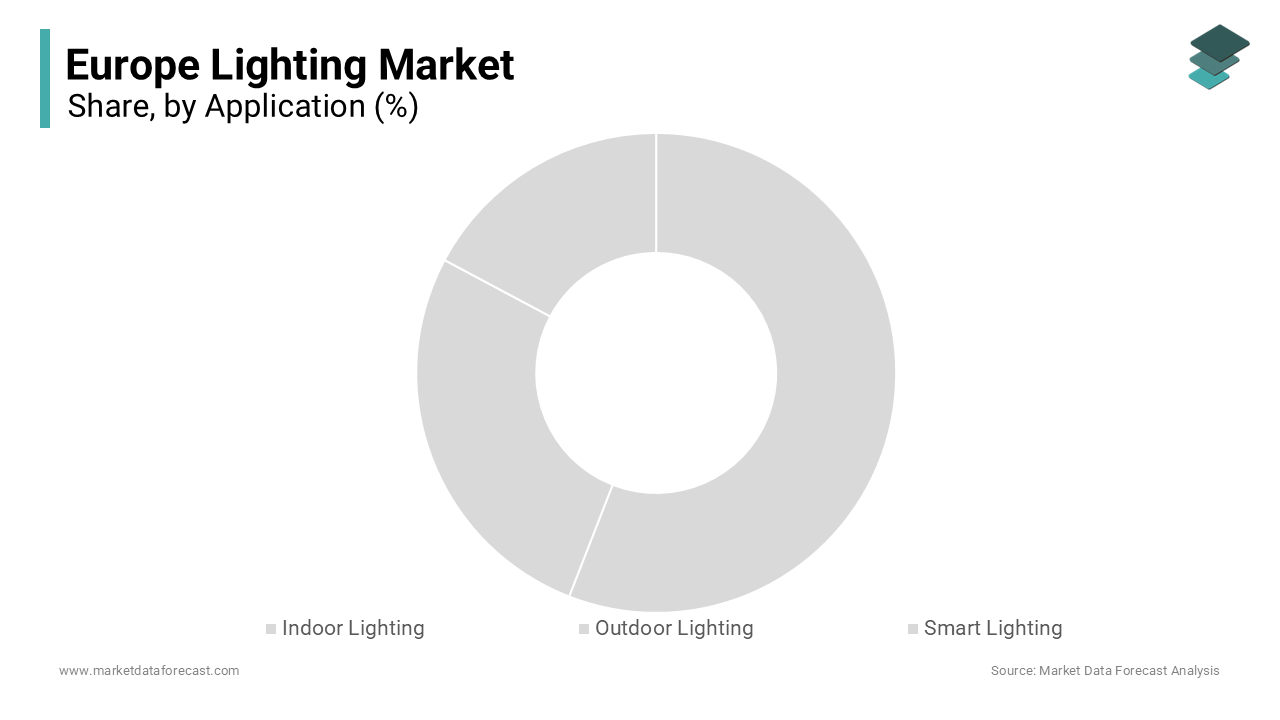
The smart Lighting segment is on the rise and is expected to be the fastest growing segment in the market by witnessing a CAGR of 14.2% from 2025 to 2033 due to integration with building management systems and occupant well being goals. New non-residential buildings in certain regions frequently incorporate advanced features such as networked LED systems, occupancy sensors, daylight harvesting technology, and tunable white light capabilities. Integrating smart lighting solutions within office environments can lead to reduced energy consumption. The use of smart lighting technology in workplaces is also associated with improvements in productivity metrics. The EU’s Energy Efficiency Directive now requires large enterprises to implement automated lighting controls in all major renovations. Furthermore, platforms like Zigbee Matter and Bluetooth mesh enable interoperability reducing vendor lock in. The shift in lighting from simple illumination to smart, data-driven environmental control provides significant value beyond just saving energy, which leads to rapid market adoption.
By Distribution Channel Insights
The offline segment maintained the majority share of 59.1% of the Europe lighting market in 2024. The leading position of the offline segment is credited to the consultative nature of professional lighting projects which require photometric planning on site diagnostics and post installation support. Sales of commercial and industrial lighting frequently involve lighting professionals, such as designers, electricians, or system integrators. These professionals often source products through specialized wholesalers. The procurement of certain lighting updates often occurs at physical trade counters. At these locations, professionals can review product demonstrations and access technical specifications and data sheets. Besides, public tenders for street lighting or school retrofits mandate face to face vendor qualification and sample validation. This B2B complexity creates a trust and expertise barrier that online channels cannot easily replicate for high value or custom solutions.
The online segment is expected to exhibit a noteworthy CAGR of 11.7% during the forecast period owing to digital-native consumers and small business owners seeking convenience and price transparency. Online platforms and retailers are increasingly adopting digital tools such as augmented reality (AR) previews and offering enhanced product information, including energy savings calculators, color temperature, lumens, and smart compatibility filters, to improve the online shopping experience and boost consumer confidence. Growth in the Benelux and other regions is further supported by government regulations promoting the adoption of LED and smart lighting solutions. Free returns and next day delivery have mitigated traditional fit and function concerns. For SMEs online platforms provide access to professional grade products without minimum order quantities. As logistics and digital tools mature online channels increasingly capture the mid tier project segment beyond simple bulb replacements.
REGIONAL ANALYSIS
Germany Lighting Market Analysis
Germany dominated the Europe lighting market by capturing a 23.6% share in 2024. The dominance of the German market is attributed to its manufacturing base, stringent building codes, and energy transition policies. The German government, through the Federal Funding for Efficient Buildings program, is actively supporting numerous energy-efficient renovation projects, which includes a strong emphasis on modern, energy-saving lighting solutions in residential and commercial properties. The country hosts global lighting innovators like OSRAM and TRILUX whose R and D centers drive human centric and smart lighting standards. Municipalities across Germany are increasingly converting public streetlights to energy-efficient LED technology, a trend driven by the desire to enhance energy efficiency, integrate smart city technologies, and significantly reduce long-term operational costs and energy consumption. Additionally, Germany’s dual vocational education system ensures a skilled workforce for complex lighting installations. This blend of policy rigor industrial capability and technical labor cements Germany’s leadership in both volume and innovation.
France Lighting Market Analysis
France was the second-largest country in the Europe lighting market and accounted for a 15.9% share in 2024. The growth of the French market is driven by aggressive public sector modernization and urban sustainability programs. Streetlight conversion efforts are taking place as part of a national initiative focused on public lighting upgrades. There is a general target for achieving full conversion to LED technology in public lighting within the coming years. In addition, municipal buildings are also undergoing significant lighting retrofits. For example, a large majority have completed upgrades that incorporate specific control systems, which are a required element for certain project sizes. Moreover, regulations related to climate and resilience are influencing new residential construction. These rules stipulate that all new homes must include specific lighting control features, such as motion sensors and systems that adjust to available daylight. Companies have established smart lighting hubs in Lyon and Paris to support these mandates. This top-down policy engine ensures consistent public demand independent of private market fluctuations.
United Kingdom Lighting Market Analysis
The United Kingdom is growing steadily in the Europe lighting market, with leadership in smart city deployments and heritage-sensitive retrofits. Public sector initiatives focus heavily on the installation of LED streetlights, with many modern installations incorporating adaptive brightness controls and environmental monitoring sensors. Simultaneously, heritage organizations are implementing specialized lighting solutions, such as custom filament LEDs, to safely illuminate historic sites including cathedrals, castles, and museums, which mitigates potential damage from ultraviolet light. Within the healthcare sector, there is an increasing adoption of guidelines for circadian rhythm lighting, which are being applied across numerous healthcare trusts. Despite Brexit the UK aligns with EU energy efficiency principles while pioneering niche applications that blend conservation with innovation.
Italy Lighting Market Analysis
Italy holds a notable position in the Europe lighting market due to its global reputation for lighting design and residential elegance. talian households exhibit a strong consumer preference for stylish and functional lighting solutions, a trend which has led to increased innovation in the domestic decorative and architectural lighting market. Concurrently, prominent Italian brands such as Flos, Artemide, and iGuzzini are major players in the global market, exporting their design-led lighting systems, including advanced LED solutions, to a worldwide customer base. The Italian Ministry of Cultural Heritage encourages the careful integration of energy efficiency approaches and high-efficiency lighting systems within historic structures to balance preservation goals with sustainability objectives. Apart from these, Italy’s high rate of home ownership fuels continuous renovation demand. Milan’s annual Euroluce fair remains Europe’s premier lighting design event influencing global trends. This fusion of artistry functionality and cultural heritage ensures Italy’s outsized influence in premium and aesthetic lighting segments.
Netherlands Lighting Market Analysis
The Netherlands is anticipated to expand in the Europe lighting market from 2025 to 2033 owing to command in connected lighting and circular economy integration. Dutch municipalities are increasingly deploying smart LED streetlights, with networks in cities like Eindhoven and Rotterdam evolving into data platforms capable of traffic, noise, and environmental monitoring. The adoption of Human-Centric Lighting in new office buildings in the Netherlands is a growing trend, driven by an increasing focus on well-being and sustainability certifications. Signify’s headquarters in Eindhoven continues to be a central hub for extensive research and development in advanced lighting technologies, including UV-C disinfection and Li-Fi communication via lighting. Additionally, Dutch recyclers like Lightcycle recover over eighty percent of luminaire materials ensuring compliance with EU circularity goals. This systemic integration of efficiency intelligence and sustainability positions the Netherlands as Europe’s smart lighting laboratory.
COMPETITIVE LANDSCAPE
Competition in the Europe lighting market is defined by a strategic shift from hardware to integrated solutions blending energy efficiency digital connectivity and human centric design. The landscape features global technology leaders regional specialists and agile startups competing on system intelligence rather than lumens per watt alone. Differentiation hinges on verified sustainability credentials interoperability with building management platforms and compliance with evolving standards for circadian lighting and data privacy. Regulatory pressure from Ecodesign and the Energy Efficiency Directive raises technical barriers favoring players with robust R and D and compliance infrastructure. At the same time commoditization in basic LED segments squeezes margins for undifferentiated suppliers. The most intense rivalry occurs in smart professional lighting where value is derived from software services and lifetime energy savings rather than initial hardware cost. As lighting becomes a strategic component of decarbonization and digital infrastructure competition increasingly centers on ecosystem integration and long term service relationships across Europe. ‘
KEY MARKET PLAYERS
Some of the notable key players in the European lighting market are
- OSRAM
- GE Lighting
- Hubbell Incorporated
- Havells India
- Cree Lighting
- Seoul Semiconductor
- Zumtobel Group AG ADR
- Signify NV
- Everlight Electronics
- Eaton Corp PLC
- Sitecore
- Nichia Corporation
- Toshiba Corporation
- Acuity Brands Inc.
- Panasonic Holdings Corp
TOP PLAYERS IN THE MARKET
- Signify N.V. headquartered in the Netherlands is a global lighting leader with deep integration across the Europe lighting market through its Philips Lighting heritage and innovation in connected systems. The company supplies LED luminaires smart city infrastructure and professional lighting solutions to municipalities hospitals and enterprises across the continent. Signify contributes to the global market by pioneering LiFi UV C disinfection and Interact IoT platforms that transform lighting into a data enabled service layer. It also launched a new generation of human centric lighting for European schools and offices aligned with WELL Building Standard requirements reinforcing its position at the intersection of health sustainability and digitalization.
- OSRAM GmbH based in Germany is a technology driven lighting specialist with strong presence in automotive specialty and industrial applications across Europe. As part of ams OSRAM the company leverages semiconductor expertise to develop high performance LEDs sensors and optoelectronic systems for smart buildings and mobility. OSRAM contributes globally by setting benchmarks in spectral precision thermal management and miniaturization for demanding environments. These innovations support Europe’s dual transition toward energy efficiency and Industry 4.0 while strengthening OSRAM’s reputation for engineering excellence and system integration in high value lighting segments.
- Schneider Electric SE headquartered in France plays a pivotal role in the Europe lighting market through its integrated building management and smart energy solutions that embed lighting as a core control node. The company’s Wiser and KNX based systems enable seamless coordination between lighting HVAC and security across residential and commercial buildings. Globally Schneider Electric advances the convergence of power management and illumination by treating lighting as both a load and a sensor network. These actions position the company as an enabler of smart electrification where lighting contributes to grid flexibility and occupant well being across Europe.
TOP STRATEGIES USED BY THE KEY MARKET PLAYERS
Key players in the Europe lighting market focus on transitioning from product sales to lighting as a service models that include installation maintenance and performance guarantees. They invest in open protocol interoperability to ensure compatibility with major smart home and building ecosystems. Companies integrate circular design principles such as modular construction and material passports to meet EU sustainability mandates. Strategic partnerships with municipalities and utilities enable large scale smart city and energy efficiency deployments. Additionally firms embed advanced controls and sensors into luminaires to transform lighting into a data platform for building intelligence and occupant health monitoring.
MARKET SEGMENTATION
This research report on the European lighting market has been segmented and sub-segmented based on categories.
By Type
- CFL
- Fluorescent Lighting
- Halogen
- HID
- Incandescent
- LED Lighting
By Application
- Indoor Lighting
- Outdoor Lighting
- Smart Lighting
By Distribution Channel
By End Use
- Commercial
- Residential
- Industrial
By Country
- UK
- France
- Spain
- Germany
- Italy
- Russia
- Sweden
- Denmark
- Switzerland
- Netherlands
- Turkey
- Czech Republic
- Rest of Europe